
macro-economic Multimodel Intercomparison Project on indirect economic impacts of extreme events (macroMIP)
Climate extremes are no longer distant threats but rather urgent tangible realities reshaping the consequences of climate change for our economy, environment and society. Each year, weather and climate-related hazards affect economic development. The impact of direct losses caused by such hazards is amplified through indirect losses caused by the interconnections and interdependencies across sectors and cascade through systems; posing systemic risks.
The aim of the macro-economic Multimodel Intercomparison Project on indirect economic impacts of extreme events (macroMIP) is to perform a stock take of the direct and indirect economic impacts of climate change and climate related extreme events in macro-economic models. This will allow a greater understanding of how these indirect impacts contribute to the total impacts on the world economy.
Future rounds of macroMIP are intended to be structured around climate and impact indicators provided by the Inter-Sectoral Impact-Model Intercomparison Project (ISIMIP).
ISIMIP outputs are generated by different biophysical impact models and provide direct expected impacts for a set of climate scenarios and socio-economic forcings (Figure 1.1). They cover damages to natural, physical, and human capital. For example, examining a climate scenario with increased frequency of heatwaves and droughts beyond current levels, agricultural models (statistical/ML or process-based) would project changes in crop yields, resulting in regionally-differentiated reductions in the productivity of the agricultural sector. Heat-labour exposure-response functions would project reductions in labour force outcomes, differentiated according to the exposure of workers in the different economic sectors and regions. Energy demand statistical modelling would project changes in energy needs by firms and households that translate into changed energy demand, and thus productivity of production processes.
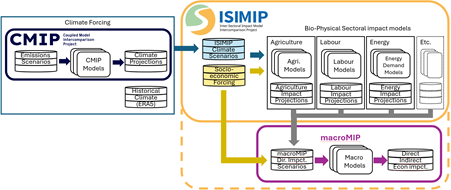
Within macroMIP, direct economic impact scenarios will be generated to capture those sectoral impacts and their effects on the macroeconomy. The experiments will contain the same socio-economic forcing used in the ISIMIP experiments. This will ensure consistency. For macroMIP exercises it will further be necessary to aggregate impacts from ISIMIP’s spatially gridded resolution to the multi-country, country, or sub-country resolution of the macroeconomic models.
The main components of the macroMIP framework are thus:
- A common set of socioeconomic data and parameters
- A common set of direct impacts
- A common modelling protocol to ensure consistency across sectors and scales in terms of data, format, and experiment set-up
Currently, the first iteration of model runs are underway following a stylized shock experiment protocol initially developed during a workshop side event of the EAERE conference 2025.
Enrolled Models
| Model Name | Home Institution | Country |
| ARIO | ETH Zürich | Switzerland |
| COIN-INT | University of Graz | Austria |
| MYRIAD | IIASA | Austria |
| MRIA | VUA | Netherlands |
| GRACE | CICERO | Norway |
| Acclimate | PIK | Germany |
| GTAP-INT, GTAP-RE (adaptive recursive), GTAP-RE (rational expectations), Classic GTAP (v7.0), Standard GTAP (v6.2) | U Melbourne | Australia |
| ICES | CMCC | Italy |
| EUROGREEN | UINIPI | Italy |
The macroMIP is organized by Jana Sillmann and Benjamin Blanz with support by Arnaz Dholakia.
If you are interested in participating in the macroMIP please contact Benjamin Blanz (benjamin.blanz@uni-hamburg.de).