Sustainability and Climate Risks
Sustainability and Climate Risks
Photo: UHH/Denstorf
1 October 2025, by Uwe Schneider
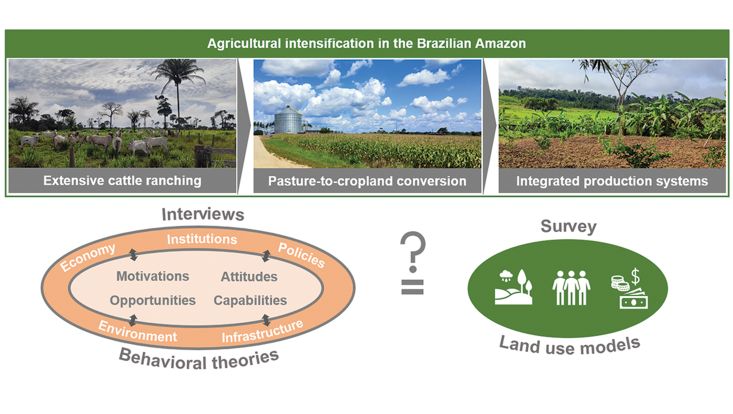
Photo: Lea Schröder
Led by Dr. Lea Schröder, FNK researchers and partners have advanced the understanding of agricultural intensification in the Brazilian Amazon—a region vital for global climate and biodiversity. Their study, published in the Journal of Land Use Science, explores both producer perspectives and the capacity of current models to predict land-use dynamics.
Interviews with 31 farm managers in Pará reveal that economic incentives encourage a shift from livestock to crop farming. However, risk attitudes, knowledge gaps, infrastructure limitations, and tenure or regulatory factors influence this transition. Many producers expressed skepticism about forestry, mainly due to long investment horizons and uncertain market conditions. The expansion of soybean and corn cultivation is expected along transport corridors, while cattle ranching will continue in remote areas.
A complementary survey among international land-use modelers assessed how well behavioral and institutional factors, such as risk attitudes, spatial heterogeneity, and infrastructure, are captured in existing modeling frameworks. Results reveal that these factors remain only partially integrated, with each model type displaying distinct strengths and weaknesses.
The authors recommend greater integration of behavioral and institutional factors to enhance the realism and policy relevance of land-use models.
Full study: https://doi.org/10.1080/1747423X.2025.2565485.