
Sustainability and Climate Risks
Sustainability and Climate Risks
Photo: UHH/Denstorf
7 July 2026
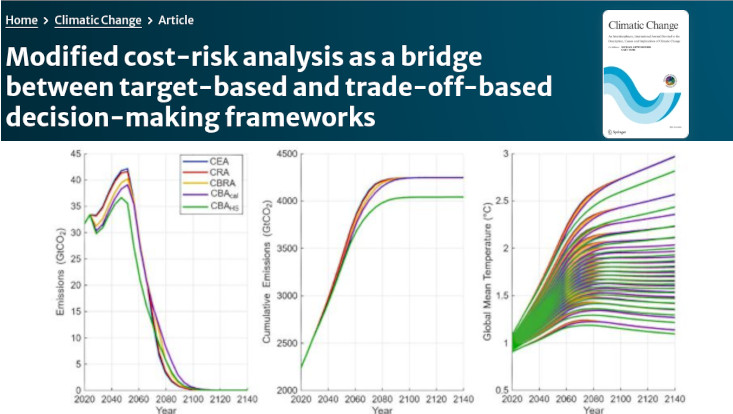
Photo: Vito Avakumovic/Benjamin Blanz
Climate economists have long faced a choice: weigh today's mitigation costs against tomorrow's quantified economic damages, or fix a precautionary temperature target and minimise the cost of meeting it, leaving those damages unquantified. A new study by Vito Avakumović, a recent PhD graduate at FNK, and Benjamin Blanz, a postdoc at FNK, proposes a decision framework that treats these two categories explicitly, rather than collapsing them into either a single damage estimate or a single precautionary target.
In their paper, “Modified cost-risk analysis as a bridge between target-based and trade-off-based decision-making frameworks”, the authors develop and apply a new framework called Cost-Benefit-Risk Analysis (CBRA). It builds on Cost-Risk Analysis (CRA), an existing hybrid that already bridges Cost-Benefit Analysis (trading mitigation costs against quantified damages) and Cost-Effectiveness Analysis (setting a target and minimising the cost of meeting it). CRA does this by replacing a rigid target with a risk penalty inside a utility-maximisation model. CBRA goes a step further, keeping that risk term, capturing the residual risk of unquantified damages, while adding an explicit partial damage function for the known impacts.
To test the framework, the researchers used the integrated assessment model MIND, coupled with a modified version of the FaIR climate emulator, incorporating a novel uncertainty scheme for climate sensitivity developed specifically for this study. The partial damage function was derived from a forward-looking, regionally and sectorally disaggregated computable general equilibrium model, covering three channels: agriculture, labour productivity, and human health.
The study shows that these explicit damages explain 58 percent of the risk captured by a 2°C climate target under a 65 percent safety level. The authors also find that, once MIND is updated with FaIR, Cost-Risk Analysis and Cost-Effectiveness Analysis produce nearly equivalent outcomes, confirming a theoretical equivalence anticipated in earlier work.
As damage estimates become more detailed, the authors argue, more of the precautionary risk embedded in climate targets can be incorporated directly into cost-benefit models — narrowing the gap between target-based and trade-off-based approaches. At the same time, uncertainty in climate sensitivity dominates over uncertainty about damages in shaping the policy recommendations, pointing to where future research may matter most.

